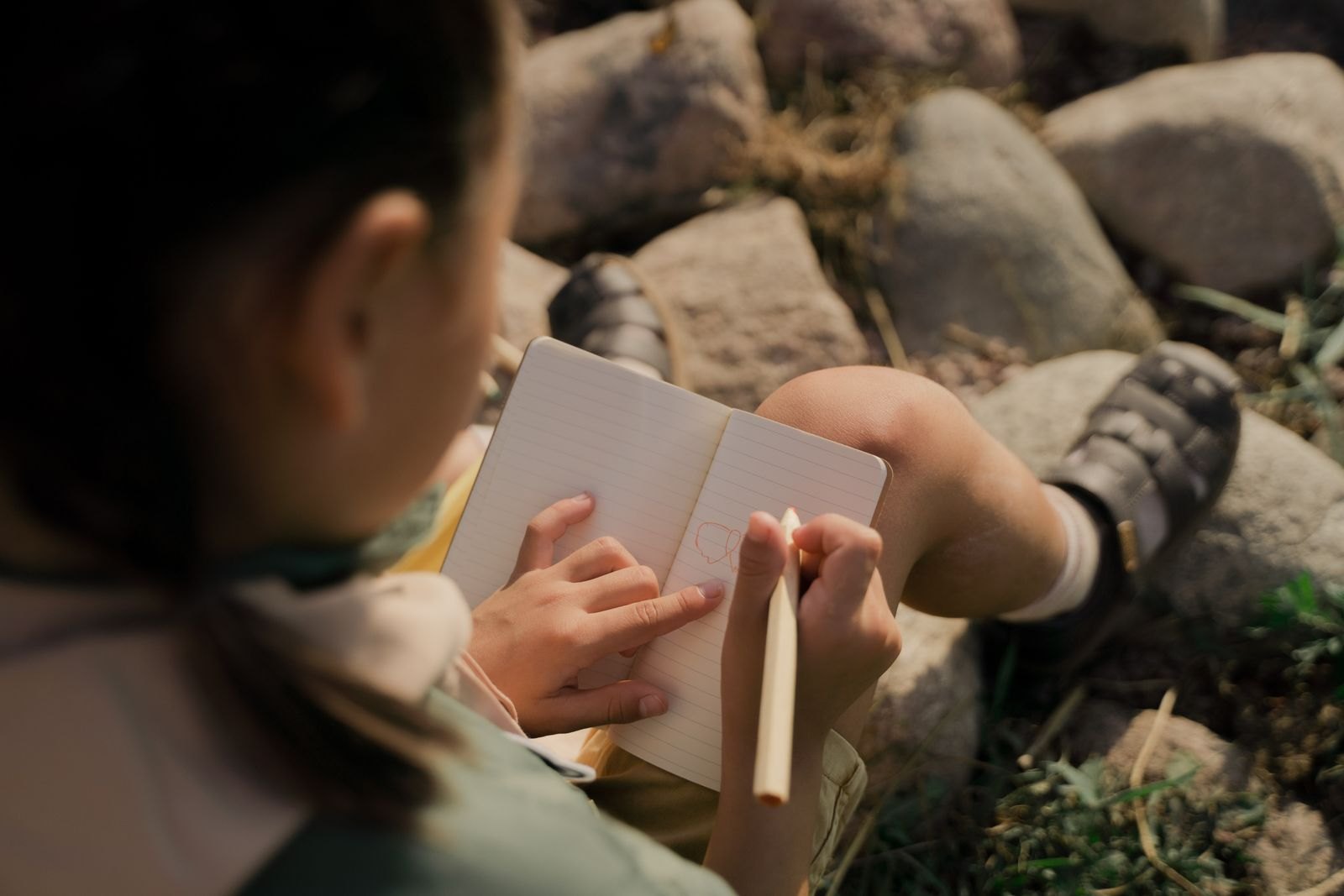
A nature notebook can begin with a single leaf drawn from a distance or a sentence about a bird heard outside. It does not need accurate illustrations, a complete species list or a special trip. The point is to give ordinary observations somewhere to land.
Choose a notebook or a few sheets that are easy to carry. A pencil may be enough. If drawing outdoors is inconvenient, make a short note and return to it at home. The notebook should support the walk rather than require everyone to stop at every possible subject.
Let the child choose the detail
A crack in a tree's bark or the way rain gathers on a leaf may be more interesting than the plant you hoped they would study. Ask what they noticed and let that determine the page. They can draw, describe, dictate to an adult or leave a space for another visit.
You do not need to name everything immediately. Write down an observation such as a small bird with a pale chest, then consult an appropriate guide later if the child remains curious. Be clear about uncertainty rather than confidently assigning a name from a quick glance.
Leave the place as you found it
Observe from a suitable distance, follow local rules and do not disturb animals, nests or plants. Avoid touching unfamiliar organisms or collecting things where it is prohibited. A picture or description can preserve the observation without removing it.
Keep the walk appropriate to the child's ability and the conditions. An adult remains responsible for traffic, terrain and supervision; a notebook can absorb attention quickly. Pause somewhere safe before drawing or reading.
Return to one familiar place
Revisiting the same tree, patch of grass or public garden can give the notebook continuity. A child may notice a difference in color, light or activity. There is no need to manufacture a finding every time; sometimes the page can simply record that it looked much the same.
Let pages remain unfinished. The notebook belongs to a series of experiences, not a display that must look consistent. Months later, a rough drawing with an enthusiastic description may recall the outing more clearly than a carefully copied diagram.