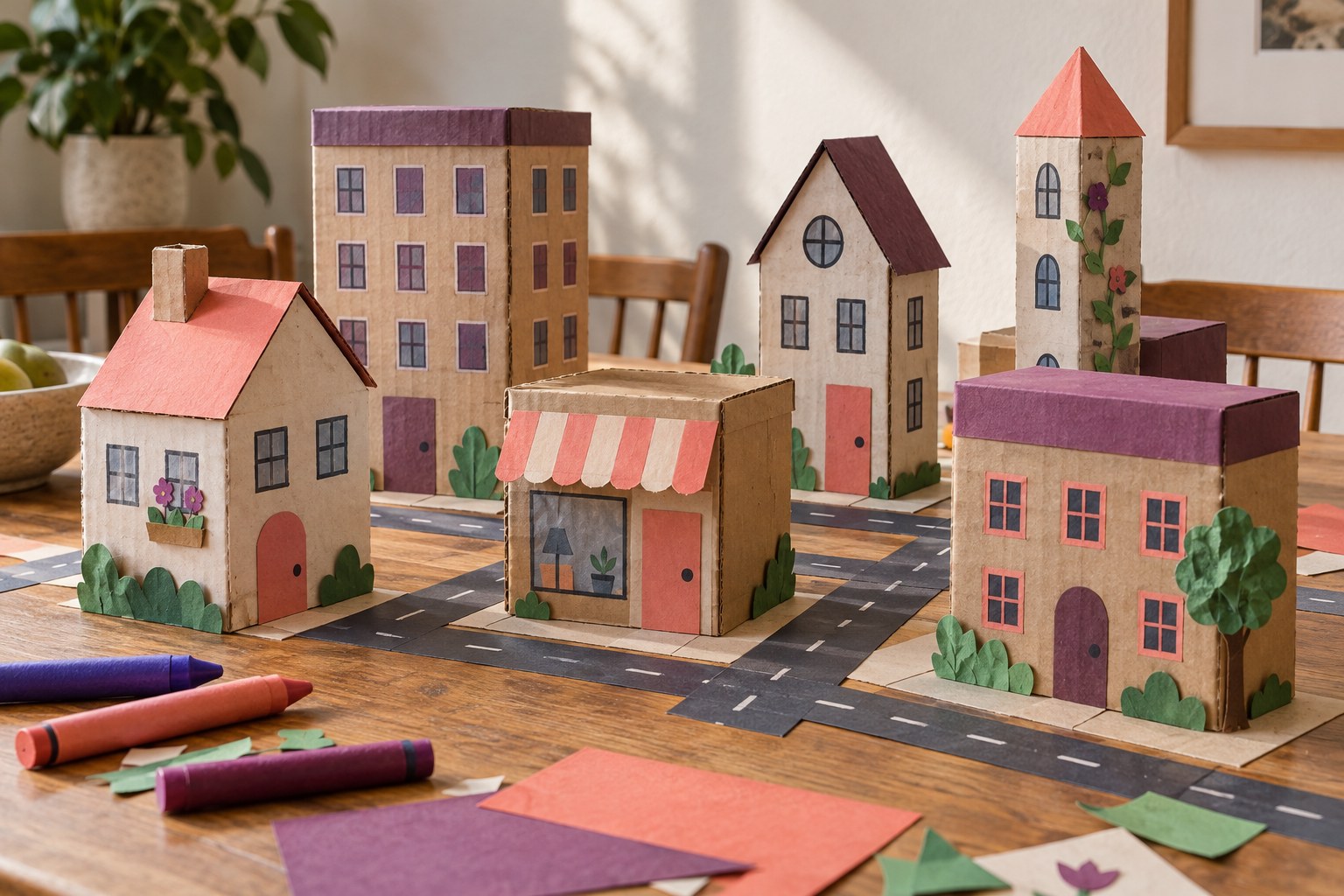
A cardboard town does not need a finished example for children to copy. A few clean boxes, a broad sheet of paper and something to draw with are enough to establish a place. The town becomes interesting when someone decides it needs a bakery, a bus stop or a home for an imaginary animal.
This version works as a tabletop project for children who can use the chosen materials with appropriate adult help. It is not a structure to climb into or stand on. Keep small offcuts, tape dispensers and other unsuitable supplies away from younger siblings, and choose art materials labeled for the children's ages.
Begin with a place, not a supply mountain
Set out two or three empty boxes with any staples, sharp edges and loose packaging removed. Use clean, dry household packaging that has not held chemicals or raw food. Adults should handle craft knives and difficult cutting; children can draw doors and windows instead of needing openings cut into every wall.
Ask what one building might be. A narrow box could become a library, but it can also become something nobody has a name for yet. Avoid correcting proportions or insisting that a house needs the features you would draw. The point is to make a setting that can support play.
Place the first building on paper and draw a road or path beside it. Removable pieces are useful: a building can move when the town needs a river, and the road can change without undoing an hour of gluing. Check that any tape you use will not damage the table or floor.
Let a small problem suggest the next piece
Rather than announcing a sequence of buildings, ask what the people in the town might need. Where could a visitor wait for a friend? How would someone get from the library to the park? A child might answer by drawing a bench or moving everything closer together.
For children of different ages, give each a meaningful contribution without assigning the oldest all the technical work. One might make signs, another arrange roads and another describe the story. Working on separate buildings can be easier than requiring everyone to agree on one shared structure.
If the activity turns into storytelling before the town is complete, follow that change. Finished windows are less important than the game that has begun. Keep scissors and unused supplies out of the play area once construction pauses.
Decide what happens when the table is needed
Choose the project's footprint before it spreads across the room. A tray or a defined part of the table makes the eventual move easier. Ask which pieces should stay together and which can go back into the materials box.
Take a photograph if the children want a record, then save a few buildings for another day or recycle the clean parts according to local rules. The town does not have to survive indefinitely to have been worthwhile. Next time, the same boxes might become a station, a theater or an entirely different place.