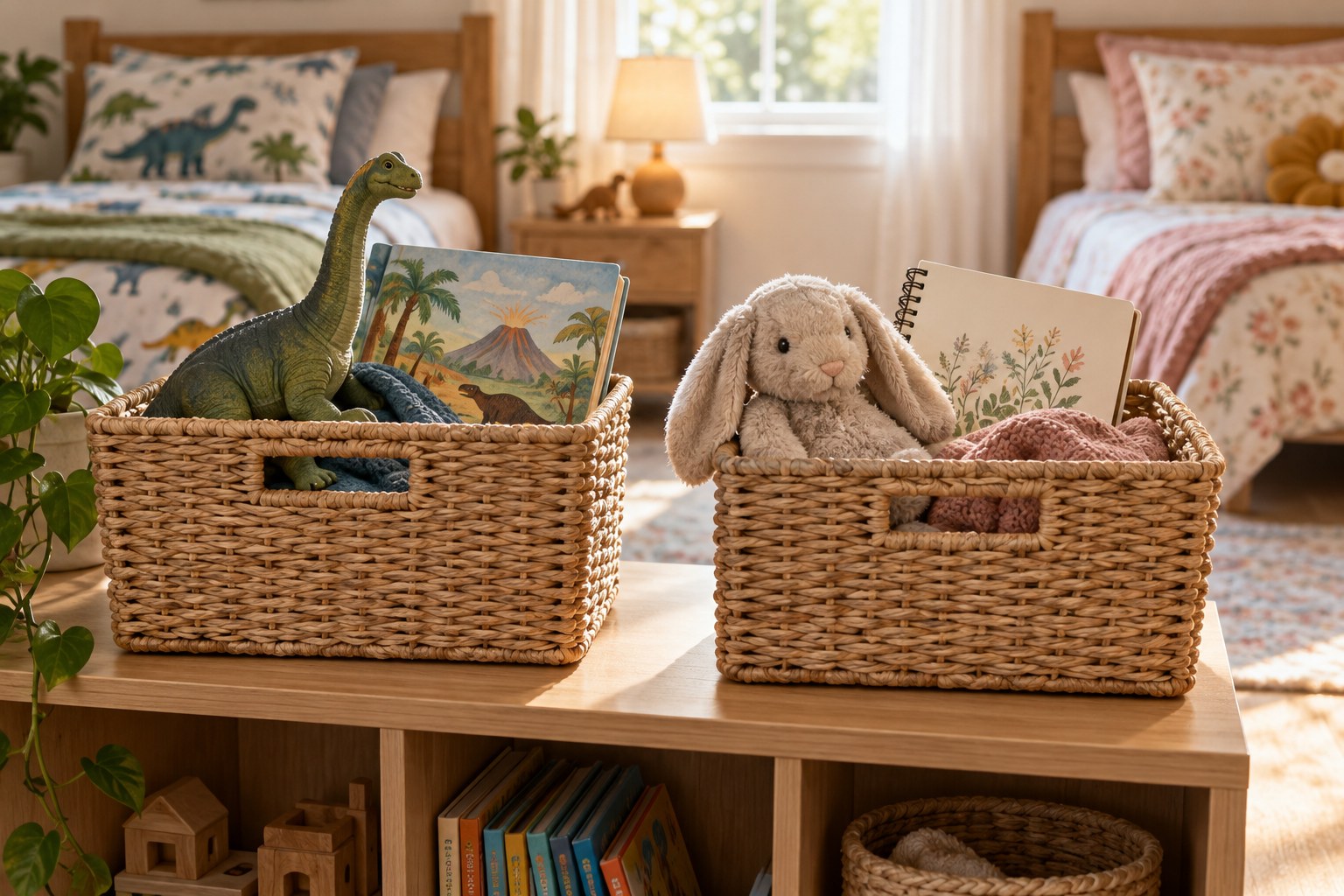
Sharing a bedroom does not mean sharing every possession. Even in a small room, each child can have a defined place for a few personal belongings. Begin with what needs to be separate and what can genuinely be shared, rather than dividing the room into equal halves automatically.
Ask about the items that matter most. A favorite book, a collection or a current project may need protection from a sibling's casual use. Agree on permission before borrowing and on a place for shared toys. Adults can help maintain those boundaries rather than expecting storage alone to solve disagreements.
Give each person a recognizable home
A shelf, drawer or suitable container may be enough. The spaces should be usable by the children according to their abilities, with furniture safely installed and anchored where required. Keep small parts and other unsuitable items inaccessible to younger siblings; a label with someone's name is not a safety barrier.
Do not place furniture or dividers where they obstruct exits, heating equipment or ordinary movement. An attractive partition is not useful if it creates a cramped or unsafe route to the door. Consider the room as a sleeping space first, then fit belongings around that purpose.
A shared-room agreement can also include a simple rule for visitors: ask before using something from the personal drawer, even if it is visible. Adults may need to remind guests and siblings while the boundary becomes familiar. If an item is particularly fragile or unsuitable around a younger child, store it in an appropriate adult-controlled place rather than expecting a verbal rule to protect it.
Handle differences openly
Children of different ages may need different amounts or types of storage. Explain the arrangement without treating identical containers as the only form of fairness. A school-age child may need a place for papers, while a younger child needs a simpler toy setup.
For example, one drawer can hold private keepsakes while a shared shelf holds everyday books. A project with small pieces can be moved to an adult-controlled area when a younger child is present. The arrangement protects the activity without making the whole room unavailable.
Review the setup as interests and routines change. Remove outgrown items with the child's involvement where appropriate, and avoid using another person's space as overflow. If one collection grows beyond its container, discuss what to keep or move rather than quietly taking a sibling's shelf.
The room does not need to look perfectly symmetrical. It needs clear places, safe movement and a few boundaries that everyone understands. Those agreements make sharing more manageable than a furniture layout chosen only for appearance.