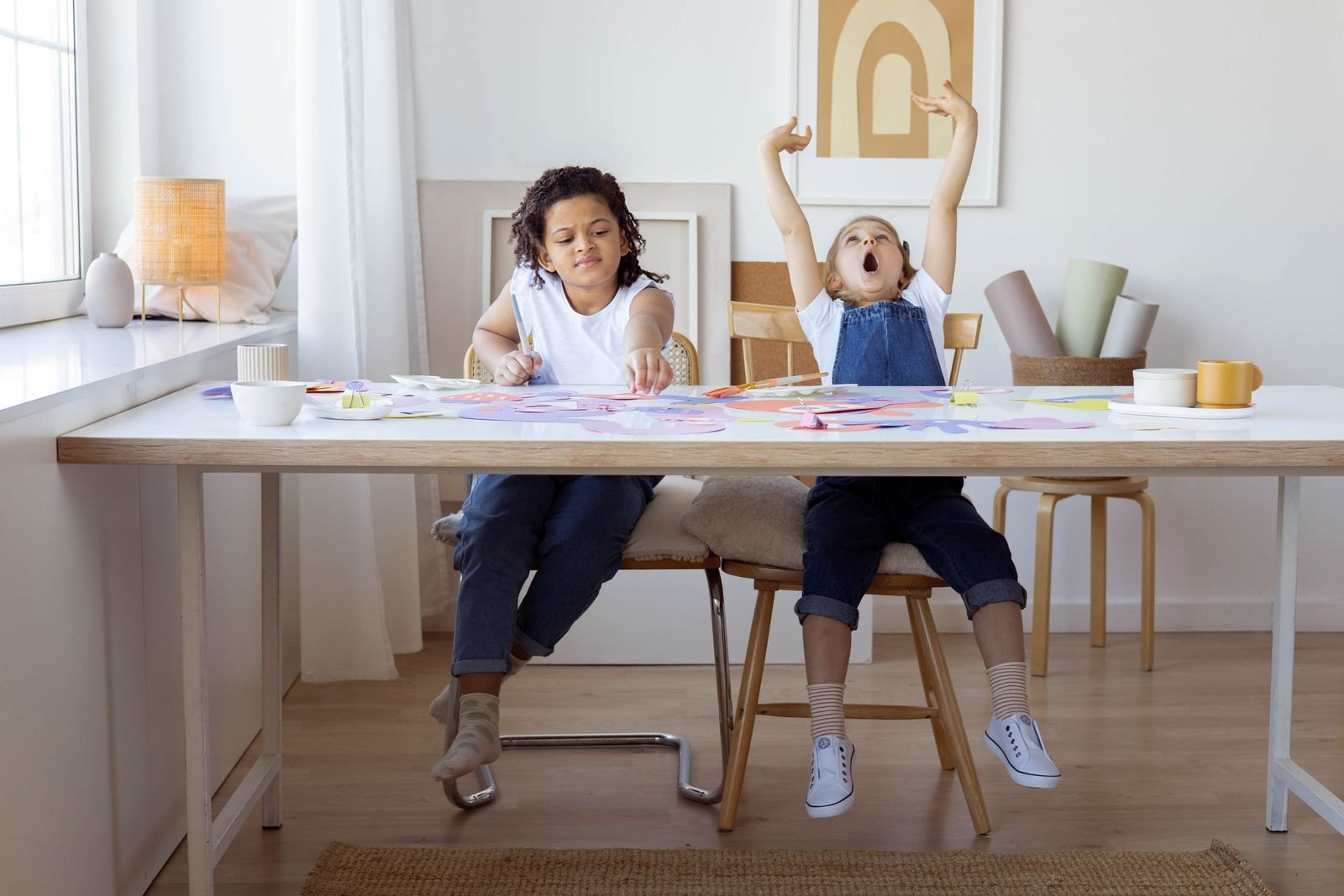
An activity for several ages does not have to produce matching results. It works better when everyone understands the broad idea and can contribute at a comfortable level. A shared drawing table, a construction area or a story game can support different kinds of participation.
Begin with the youngest child's safety needs and the supervision available. Materials suitable for an older child may be inappropriate for a younger sibling. Separate work areas or different supplies may be necessary; asking an older child to watch the younger one is not a substitute for the adult's responsibility.
Choose a flexible theme
For a pretend town, one child might arrange large buildings while another writes signs. For a story, one might choose a character and another describe where it goes. These are examples, not permanent jobs assigned by age.
Ask what each child wants to do. An older child may enjoy the simplest part, while a younger child may want help with a more detailed idea. Offer assistance without turning the activity into a comparison of ability.
Protect ownership within the shared space
Decide whether everyone has their own project or whether the materials form one collective result. If the work is shared, explain what needs permission before being changed. Dismantling a sibling's structure can end the activity quickly even when the original intention was collaborative.
Keep some resources separate if constant sharing makes the task frustrating. Two small sets of drawing tools may be more useful than one enormous set everyone has to reach across. A clear turn can help with a scarce item, but the activity should not consist mostly of waiting for it.
One theme, three different contributions
Suppose the group chooses to make an imaginary park. A younger child could arrange large, suitable blocks as paths, another could draw a play area and an older child could design signs or invent a story about the visitors. These options share a setting but do not depend on everyone completing a precise step at the same time.
Before beginning, decide which parts are shared. If the path must remain in place while another child uses it, explain that agreement. If each person has a separate sheet, they can change it independently. The clearer the ownership, the less an adult needs to referee every alteration.
The theme can also divide into separate interests. One child may turn the park into a zoo while another continues drawing a picnic spot. If the materials and space permit both, there is no reason to force the projects back into one story. Shared time can contain several ideas without losing its purpose.
Allow different finishing times
Someone may finish quickly and want to leave while another continues. Have an appropriate next option available and keep supervision clear. Do not require the fast finisher to improve the slower person's work or make the younger child stay until the oldest is satisfied.
If the shared activity repeatedly breaks down, simplify it or let the children do separate things nearby. Being together does not require identical play. The strongest mixed-age session leaves each person with some choice and avoids making one child the helper, judge or obstacle throughout.